
Meet the Grief App Creators
We built The Grief App out of one belief: that real grief support
should exist for everyone, and be there the moment it’s needed.
Between us we’ve lived the loss, sat with it clinically, and walked
families through it — and we built the resource we all wish had
existed.

Saundra Neperud
Widow & Founder
Saundra Neperud has lived a full and unusual life. She predicted Old Faithful as a volunteer ranger, led boat tours to calving glaciers in Alaska, served in the Peace Corps in Thailand, taught on the Navajo Nation and Hopi Reservation, and owned a hotel in Maine. She started nonprofits, coordinated disaster response, and said goodbye to countless people along the way, often knowing she might never see them again. She thought she understood loss.
Then at 41, she met Eric Neperud, the love of her life. Two weeks after they got engaged, her mother was diagnosed with stage 4 cancer and died eight months later. Eleven years after that, Eric was told he might have stage 4 cancer too. He died before the biopsy results came back.
After Eric’s death, Saundra spent a year focused on her mental health, and ran headfirst into how hard grief support is to find. She couldn’t locate a single secular, in-person grief group in her entire city. The therapist her insurance covered had no grief experience, and it helped so little she stopped after a few sessions. She bought books, but her grief-fogged brain could barely manage the simplest exercises. It amazed her that help was this hard to find, when people die every day.
A year after Eric’s death, someone showed Saundra an app built to help people stop drinking, and she realized something similar could help people understand and work through grief. She began interviewing hospice nurses, therapists, grief counselors, and funeral directors to learn what people in mourning actually need. That’s how she met Emily, and The Grief App began to take shape.

Emily J. Danekas, L.M.F.T.
Grief Specialist & Licensed Therapist
Emily J. Danekas is a Licensed Marriage and Family Therapist with a master’s degree from Seattle Pacific University and a certification in Death and Grief Studies from Alan Wolfelt’s Center for Loss and Life Transition. She has practiced for twenty years in general counseling and nearly ten specializing in grief care. She is one of the only grief therapists serving her three-county area.
When adults asked her as a child what she wanted to do when she grew up, she said she wanted to help people. That answer led her to counseling. It didn’t lead her to grief work — that came later, and it came by accident. In 2013 a friend unexpectedly lost her husband, and Emily fell into a support role beside her. Walking with her through that loss, Emily recognized she had a gift for being in that space. She went out and got trained for it.
She is drawn to grief care because every experience of it is singular and no one is exempt. She can sit with pain without feeling compelled to fix it. She is comfortable in silence, because words are inadequate to grief and pretending otherwise helps no one. And she has always loved people’s stories — in grief care she gets to be there while her clients recall and share memories of the person they lost. She considers it an honor to hold those memories, and sacred to share time with someone who is actively dying.
On The Grief App, Emily is the clinical foundation. She reviewed every function to ensure it is sound and appropriate for someone in the middle of grief, originated the audio journal, and co-wrote the guidance, wording, and the majority of the workbook activities. The scarcity she works inside of is the reason she wanted to build it: there are too few resources for the bereaved, and people need something they can reach when they need it, not only inside a therapist’s office. Her clinical judgment is why the app feels less like software and more like sitting with someone who understands.
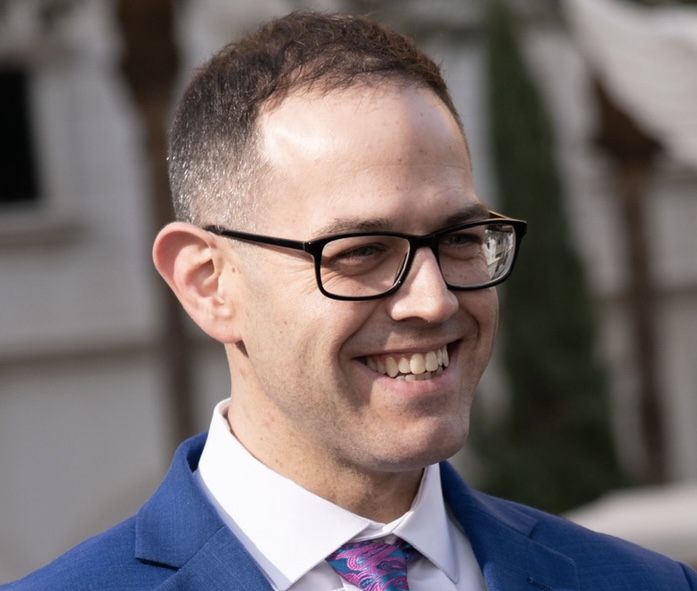
Adam Annable, MS, FT, CT, CFSP
Grief Specialist
Adam is a Certified Fellow in Thanatology, Certified Grief Coach, as well as a Licensed Funeral Director and Certified Funeral Service Practitioner, with decades of experience researching and working with grief and bereavement.
Adam holds a Master of Science degree in Thanatology, a Bachelor of Science degree in Psychology, and a Bachelor of Science degree in Funeral Service. He volunteers as a mentor for aspiring and newly-licensed funeral directors with the Continuing the Vision Mentorship Program, with which he is also a member of the Administrative Team. He also facilitates grief support groups with HealGrief.org. As a Grief and Death Care Educator, Adam is an Instructor for the Center for Death Education, and creates content as an Expert Contributor for the Help Texts text-based aftercare program.
Adam’s passion for grief work is anchored in years spent working in acute health care settings, and his more recent years working as a licensed funeral director, as well as his own experience as a human who has grieved. Experiencing the grief process in an anticipatory setting before a death has occurred, as well as counseling bereaved families and friends as a licensed funeral director as the grief process (often rapidly) unravels after a death has occurred, has fundamentally shaped how he sees and approaches grief, and has made his desire to engage in helping others through their grief that much more significant.
It is his belief that there is one universality in the grief experience: no grief experience is greater or less than the experience of another. Grief wears many more masks than one, and it looks entirely different from person to person.

How It Came Together
When Saundra and Emily connected, they had something powerful: lived experience meeting clinical expertise. Saundra knew what it felt like to need help and not find it. Emily knew what tools could actually make a difference. They spent a year developing The Grief App, combining Cognitive Behavioral Therapy with real-world understanding of what people need when they’re grieving. Professional without being clinical.
As the app grew, Adam joined, bringing the perspective of a thanatologist and funeral director, someone who sits with families in the rawest days right after a loss and walks with them through the grief that follows. Together, the three of them cover grief from every side: the lived, the clinical, and the professional.
Compassionate without being patronizing.
Available exactly when you need it.